End of Year Functions – a timely reminder
The time of year for Christmas/end-of-year work events is fast approaching. Many workplaces across Australia big, small and of all industries, will most likely host some sort of social function/event. All staff are invited, and everyone has permission to let their hair down…’ or do they?
As night follows day almost inevitably at Liquid HR we receive a slew of queries from clients about how to manage an employee who ‘let their hair down’ and manage the fall-out of said employee’s actions that have caused a rift between their co-workers that may be irreparable. Let’s not mince words any further, we’re talking about all manner of drunken disorderly or aggressive behaviour, some so inappropriate it may be serious misconduct and downright unlawful, e.g. physical, assault, sexual assault or harassment. It may sound extreme, but it does and has happened.
So, what should employers do? Be a Christmas Grinch and have no celebration at all? That is an option but ironically, employees of some organisations who do not have Christmas/end-of-year events arrange their own event, don’t invite their employer who did not organise the event and spend most of the party bemoaning their employer for not organising an event anything else that has gotten under their skin the past year.
Employers naturally want to make the event as enjoyable as possible. However good intentions can sometimes go awry. Take, for example, one employer who organised a masked fancy dress party. One employee showed up wearing the mask of a grotesque character from a horror film, much to his co-workers, well, horror. Other employees (the horror mask wearer included) had full face masks that restricted them from eating, drinking and talking to one another. It wasn’t before long that masks were being shed and by the end of the night, the masked party had become, unmasked.
Another employer organised a belly dancer for entertainment, which probably seemed innocuous on paper. That is, until the dancer started getting employees up on their feet and dancing seductively with them, all the while their co-workers laughed raucously at them. Some employees not wanting to be targeted walked out of the event. Some later returned and others did not.
All of these trappings, need careful consideration lest an employer finds themselves the target of a claim for harassment, bullying or worse. The effect may be amplified when alcohol has been consumed.
This brings me to the rules. Ultimately you as the employer bear responsibility for the event and all in attendance almost exclusively. Employers must lay down the rules for the event well in advance that strike the right balance between the standard of behaviour expected yet allows for some fun and frivolity.
We recommend the following;
Outline all the standards and rules expected in a workplace social events policy (which should cover the points below) and provide all employees with a reminder of the policy prior to the event.
If alcohol is provided, it should not be consumed to excess- the bar tab will help (financially as well) and so too will a cut-off time for the bar tab.
Again, if alcohol is provided, ensure those who have consumed alcohol do not get in a car if they are over the limit.
Except for arranging transport for employees to get home, the employer is not liable for all other activities that happen after the event. Therefore, it is not recommended you suggest and accompany employees to ‘hit the town’ after the sanctioned event ends, lest you be held liable for any shenanigans that follow the sanctioned event.
A no-brainer but leave nothing to chance; recreational drugs should not be permitted or consumed at the event.
And finally, any behaviour that would not be appropriate in the workplace should not be permitted or tolerated at the event. A behaviour notification template for work functions is available in the Liquid HR Resource Hub.
With these basic rules in mind and some reasonable, considered planning, your event should do just fine. And remember, as the saying goes, Christmas comes but once a year.
Paid Family and Domestic Violence Leave to commence from 1 February 2023
All full time, part time and casual employees will be able to access 10 days of paid family and domestic violence leave each 12 months. This will be effective from 1 February 2023 for employers with 15 or more employees and from 1 August 2023 for small business employers (employers with less than 15 employees).
To support clients in rolling out this new entitlement, we have drafted a Paid Family and Domestic Leave policy which can be accessed in the Liquid HR Resource Hub. Employers should also take the necessary steps to update their payroll system leave accruals and contract templates to reflect the new entitlement.
Labor Government IR Reforms before Parliament
The Australian Government has put forward the most substantial changes we have seen to the Industrial Relations framework since the Fair Work Act was introduced in 2009. The Secure Jobs, Better Pay Bill was introduced to the House of Representatives on 27 October 2022 and there have been subsequent amendments made throughout the process. Whilst the Bill is still subject to review by the Senate, below are some of the major changes we may expect:
- Multiple employer enterprise agreements – currently enterprise agreements generally cover one employer and the employees that work for that employer. Under the new proposed arrangements, employers can be forced into bargaining with multiple employers (including competitors). This will be one of the most significant changes we have seen in enterprise bargaining agreements.
- BOOT test for enterprise agreements – simplifying the process
- Industrial action – the removal of some limitations on protected industrial action
- Equal pay – increased powers for the FWC to make Equal Remuneration Orders (that is remuneration increases outside the normal annual review process), as well as the banning of pay secrecy clauses in contracts of employment, allowing employees to openly discuss their remuneration without facing a breach of contract claim.
- Flexible work requests – increasing the scope and limiting the reasons for refusal that a business may rely upon
- Fixed term contracts – limiting the scope and application. Inability to engage an employee on a fixed term contract of more than 2 years, with exceptions for some industries.
Liquid HR is monitoring the Bill review process closely and will be sure to provide detailed advice and support to clients regarding the changes, once the bill becomes legislation. The Australian Government were hoping to have the bill passed by 1 December 2022. Given the current timing, we expect the review will continue into next year.
Aged Care Workers receive 15% increase
The Fair Work Commission has the power to increase wages if there is a difference in pay between employees undertaking equivalent work in a different setting. Under the Aged Care Work Value Case, unions were requesting a 25% pay increase.
The work value case found that aged care workers in the aged care sector were underpaid when compared to other care workers. A 15% increase was determined appropriate to address the current inequity.
The increase will apply to aged care workers covered under the following awards:
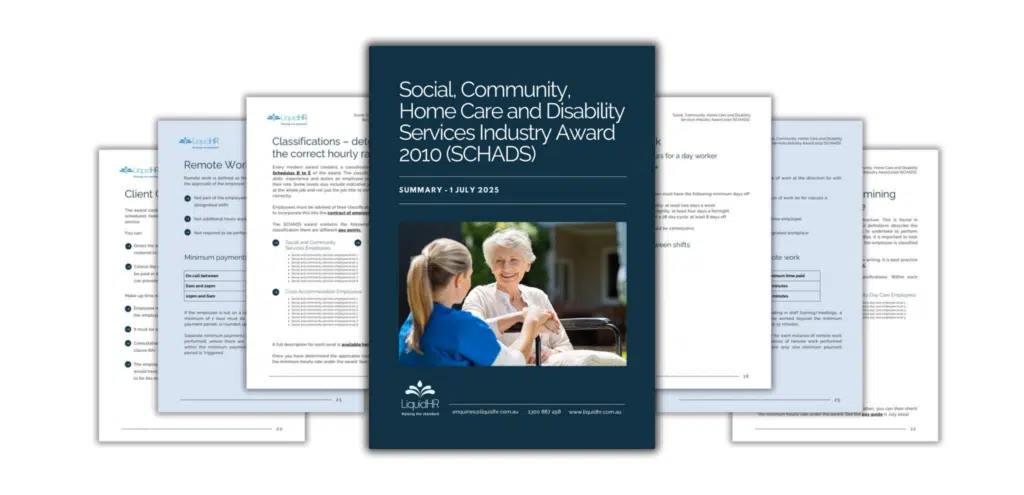
- The Social, Community, Home Care and Disability Services Award 2010
- The Aged Care Award 2010
- The Nurses Award 2020
The timing of the increase has not yet been determined. A follow up conference has been scheduled for 22 November 2022.
For more information on the above, please contact us on 1300 887 458 and speak with one of our HR Consultants. If you are interested in learning more about our HR services, including HR Outsourcing, HR Consulting, HR Advisory Services, contact us at enquiries@liquidhr.com.au.